त्रैमासिक परीक्षा 2026 – हेतु जारी ब्लू प्रिंट एवं पाठ्यक्रम के आधार पर इस पोस्ट में मॉडल / प्रैक्टिस प्रश्न पत्र कक्षा 12 अंग्रेजी दिया गया है , इसमें से कुछ या बहुत से प्रश्न आगामी परीक्षावों हेतु उपयोगी रहेंगे . विद्यार्थी अवश्य अभ्यास करें .
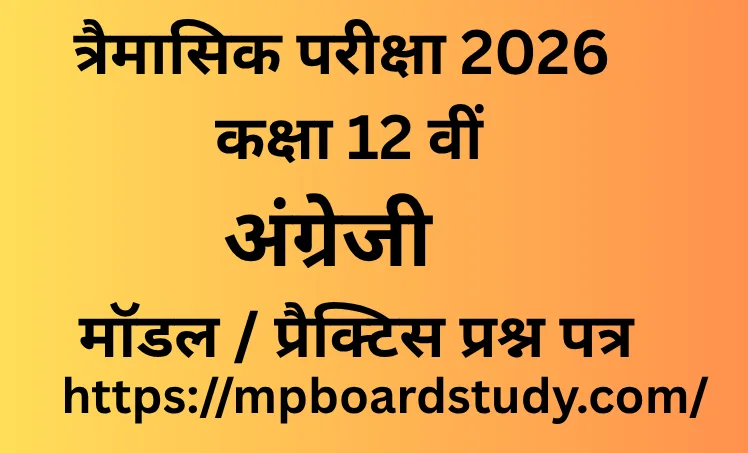
त्रैमासिक परीक्षा 2026 कक्षा 12 वीं अंग्रेजी
Quarterly Examination (Model Paper)
Class: 12
Subject: English
Time Allowed: 3:00 Hours
Maximum Marks: 80
Instructions:
- All questions are compulsory.
- Marks are indicated against each question.
- Read the instructions carefully before answering.
SECTION A: READING SKILLS (14 Marks)
Q1. Read the following passage carefully and answer the questions given below: (1 × 10 = 10 Marks)
“Education is not just about gathering information; it is a mechanism to transform the human mind and soul. In modern times, the definition of literacy has evolved. It is no longer restricted to knowing how to read and write, but extends to digital and functional literacy. However, the foundational pillar remains reading. Regular reading sharpens the intellect, broadens perspectives, and builds empathy. When an individual reads a book, they engage in a silent conversation with the author across time and geography. Unfortunately, in the digital age, attention spans are shrinking. Scrolling short video clips has replaced turning pages. While technology provides instant access to global databases, it cannot replicate the deep focus and cognitive growth attained through reading long-form text. Educational institutions globally are recognizing this crisis and reintroducing dedicated reading hours to foster a holistic generation capable of critical thinking rather than superficial consumption.”
Questions:
(i) According to the passage, what is the ultimate purpose of education?
(a) To pass exams (b) To gather information (c) To transform the mind and soul (d) To learn coding
(ii) How has the definition of literacy changed in modern times?
(a) It is limited to reading (b) It now includes digital and functional literacy (c) It has become obsolete (d) It means memorizing facts
(iii) What is a major side effect of the digital age mentioned in the passage?
(a) Increase in wealth (b) Shrinking attention spans (c) Better health (d) Improved memory
(iv) Why can short videos not replace books?
(a) Videos are expensive (b) Books are colorful (c) Videos don’t allow deep focus and cognitive growth (d) Books are short
(v) Regular reading builds:
(a) Physical strength (b) Empathy and intellect (c) Confusion (d) Laziness
(vi) Find a word from the passage which means ‘to nurture or encourage growth’.
(a) Replicate (b) Foster (c) Gather (d) Shrink
(vii) What does a reader engage in while reading a book?
(a) A verbal dispute (b) A noisy debate (c) A silent conversation across time (d) A technical code
(viii) Educational institutions are reintroducing dedicated reading hours to encourage:
(a) Rote learning (b) Critical thinking (c) Video creation (d) Sports culture
(ix) State whether True or False:Technology perfectly replicates the deep cognitive growth obtained through reading long-form text.
(x) Complete the sentence:The foundational pillar of modern literacy still remains ______________.
Q2. Read the passage carefully and answer the questions that follow: (4 Marks)
“Effective time management is a skill that can turn failure into success. Students often struggle with balancing academic workloads, extracurricular commitments, and leisure. The first step towards managing time efficiently is prioritization. Using a matrix to divide tasks into ‘Urgent’, ‘Important’, and ‘Non-essential’ helps eliminate clutter. Secondly, consistency beats intensity. Studying two hours every day is far more productive than cramming for fourteen hours a night before the final test. Lastly, taking planned, systematic breaks (like the Pomodoro technique) avoids burnout and keeps the retention rate high.”
Questions:
(a) On the basis of your reading of the above passage, make notes on it using headings and subheadings. Use recognizable abbreviations where necessary. (3 Marks)
(b) Supply a suitable title to the passage. (1 Mark)
SECTION B: WRITING SKILLS (12 Marks)
Q3. You are Alok/Anjali, the Cultural Secretary of Your School. Draft a Notice in not more than 50 words informing students about an upcoming Inter-School Debate Competition to be held next month. (4 Marks)
OR
Design an attractive, educational Poster to raise awareness among young students about the hazardous effects of using single-use plastics.
Q4. Write a Letter to the Postmaster of your area complaining against the irregular and late delivery of important letters and couriers in your locality. You are Rahul/Riya residing at 12, Nehru Nagar. (4 Marks)
OR
Write an informal letter to your younger brother advising him to take part in physical sports and limit his daily screen time on electronic gadgets.
Q5. Write an Article/Report in about 120–150 words on the topic: “The Importance of Planting Trees for a Sustainable Future”. (4 Marks)
OR
Prepare a Speech to be delivered in the morning assembly on “The Role of Discipline in a Student’s Life”.
SECTION C: GRAMMAR (10 Marks)
Q6. Fill in the blanks with correct alternatives: (1 × 5 = 5 Marks)
(i) He did not buy ________ apples from the vendor. (some / any / many)
(ii) My brother is ________ NCC cadet. (a / an / the)
(iii) You ________ respect your elders and teachers. (ought to / can / may)
(iv) The train ________ before we reached the railway station. (left / had left / leaves)
(v) Walk carefully lest you ________ stumble. (should / would / could)
Q7. Do as directed: (1 × 5 = 5 Marks)
(i) As soon as the thief saw the police, he ran away. (Rewrite using ‘No sooner … than’)
(ii) He is too weak to lift this heavy box. (Rewrite using ‘so … that’)
(iii) They were playing football in the school playground. (Change into Passive Voice)
(iv) If you do not study hard, you will fail the quarterly exam. (Rewrite using ‘Unless’ in place of ‘If’)
(v) He said to me, “Where are you going tonight?” (Change into Indirect Speech)
SECTION D: TEXTBOOKS (44 Marks)
Q8. Read the following extract from Prose (Flamingo) and answer the questions: (1 × 5 = 5 Marks)
“Poor man! It was in honour of this last lesson that he had put on his fine Sunday clothes, and now I understood why the old men of the village were sitting there in the back of the room. It was because they were sorry, too, that they had not gone to school more. It was their way of thanking our master for his forty years of faithful service and of showing their respect for the country that was theirs no more.”
Questions:
(i) Who is referred to as the ‘Poor man’ in the extract?
(a) Franz (b) M. Hamel (c) The Mayor (d) Old Hauser
(ii) Why were the old men of the village sitting at the back of the classroom?
(a) To check the class (b) To pass the time (c) To show respect and express regret (d) To study grammar
(iii) For how many years had the master served the school faithfully?
(a) 20 years (b) 30 years (c) 40 years (d) 50 years
(iv) Which chapter does this text belong to?
(a) Lost Spring (b) Deep Water (c) The Last Lesson (d) The Rattrap
(v) Find a word from the extract which means ‘loyal or dedicated’.
(a) Honour (b) Respect (c) Faithful (d) Service
Q9. Read the extracts given below and answer the questions:
(A) From Poetry (Flamingo): (1 × 3 = 3 Marks)
“…and looked out at Young
Trees sprinting, the merry children spilling
out of their homes, but after the airport’s
security check, standing a few yards
away, I looked again at her, wan, pale
as a late winter’s moon…”
Questions:
(i) Name the poem and its poet.
(a) Keeping Quiet – Pablo Neruda (b) My Mother at Sixty-Six – Kamala Das (c) A Thing of Beauty – John Keats (d) A Roadside Stand – Robert Frost
(ii) What do ‘sprinting trees’ signify?
(a) Slow motion (b) High speed driving (c) Fast passing youth and vitality (d) Green nature
(iii) Why is the mother compared to a ‘late winter’s moon’?
(a) Because she is glowing (b) Due to her loss of radiance, energy, and pale looks (c) Because it was December (d) Because she loved winter
(B) From Supplementary Reader (Vistas): (1 × 4 = 4 Marks)
“To assure himself, he walked over to a newsboy and glanced at the stack of papers at his feet. It was the World; and The World hasn’t been published for years. The lead story said something about President Cleveland. I’ve found that front page since, in the Public Library files, and it was printed June 11, 1894.”
Questions:
(i) Who is the speaker here?
(a) Sam (b) Charley (c) Louisa (d) The Psychiatrist
(ii) Which newspaper did he see at the newsboy’s feet?
(a) The New York Times (b) The World (c) The Daily Mirror (d) The Horizon
(iii) What date was printed on that historical front page?
(a) June 11, 1994 (b) June 11, 1894 (c) July 4, 1789 (d) March 4, 1894
(iv) Name the chapter from which this extract has been taken.
(a) The Tiger King (b) The Enemy (c) The Third Level (d) On the Face of It
Q10. Answer any FIVE of the following short answer type questions from Prose (Flamingo) in about 30 words: (2 × 5 = 10 Marks)
(i) What had been put up on the bulletin-board at the town hall in The Last Lesson?
(ii) What is Saheb looking for in the garbage dumps? Where has he come from?
(iii) Why was Douglas determined to get over his deep-seated fear of water?
(iv) From where did the peddler get the philosophical idea of the world being a rattrap?
(v) What does the title ‘Lost Spring‘ symbolize or mean?
(vi) Why did M. Hamel write “Viva La France” on the blackboard at the end of the class?
Q11. Answer any THREE of the following short answer type questions from Poetry (Flamingo) in about 30 words: (2 × 3 = 6 Marks)
(i) What is the kind of pain and ache that the poet feels in My Mother at Sixty-Six?
(ii) What does the poet Pablo Neruda mean by advocating ‘exotic moment’ and ‘total inactivity’?
(iii) According to John Keats, what removes the pall of despondency from our dark spirits?
(iv) Why are the young children described as ‘merrily spilling out of their homes’?
Q12. Answer any TWO of the following short answer type questions from Supplementary Reader (Vistas) in about 30 words: (2 × 2 = 4 Marks)
(i) What does the psychiatrist friend Sam say about Charley’s claim of discovering the third level?
(ii) Why did the Maharaja of Pratibandapuram resolve to hunt and kill one hundred tigers?
(iii) What unique features make Antarctica an ideal destination to study the Earth’s past, present, and future?
Q13. Answer any TWO of the following long answer type questions from Prose (Flamingo) in about 75–100 words: (3 × 2 = 6 Marks)
(i) How does the order from Berlin suddenly change the whole atmosphere and perspective of the school in The Last Lesson?
(ii) Compare and contrast the contrasting lives of Saheb-e-Alam and Mukesh as depicted in Lost Spring.
(iii) Explain how Douglas’s experience at the YMCA pool structuralized his life and how he finally conquered his terror.
Q14. Answer any ONE of the following long answer type questions from Poetry (Flamingo) in about 75–100 words: (3 Marks)
(i) Central idea of the poem Keeping Quiet by Pablo Neruda.
OR
(ii) Elaborate on the theme of aging and filial separation as presented by Kamala Das in My Mother at Sixty-Six.
Q15. Answer any ONE of the following long answer type questions from Supplementary Reader (Vistas) in about 75–100 words: (3 Marks)
(i) Detail how the story The Third Level masterfully interweaves psychological psychological escapism, fantasy, and harsh reality.
OR
(ii) How did the astrologer’s prediction come true regarding the ultimate fate of the arrogant Tiger King?
आपके लिए यह भी उपयोगी हो सकता है –
त्रैमासिक परीक्षा कक्षा 12 हिंदी मॉडल / प्रैक्टिस पेपर हल करें
शैक्षणिक सत्र 2026-27 के लिए हिन्दी माद्यम के छात्रों के सभी प्रकार की शैक्षणिक सामग्री एम् पी बोर्ड स्टडी डाट काम ( https://mpboardstudy.com/) पर उपलब्ध है जबकि अंग्रेजी माध्यम के लिए एम् पी बोर्ड इंग्लिश मीडियम डाट काम ( https://mpboardenglishmedium.com/) देखें . विमर्श पोर्टल डाट इन ( https://vimarshportal.in/) भी एक उपयोगी वेबसाईट है .
व्यावसायिक शिक्षा के लिए वोकेशनल एजुकेशन डाट इन ( https://vocationaleducation.in/)